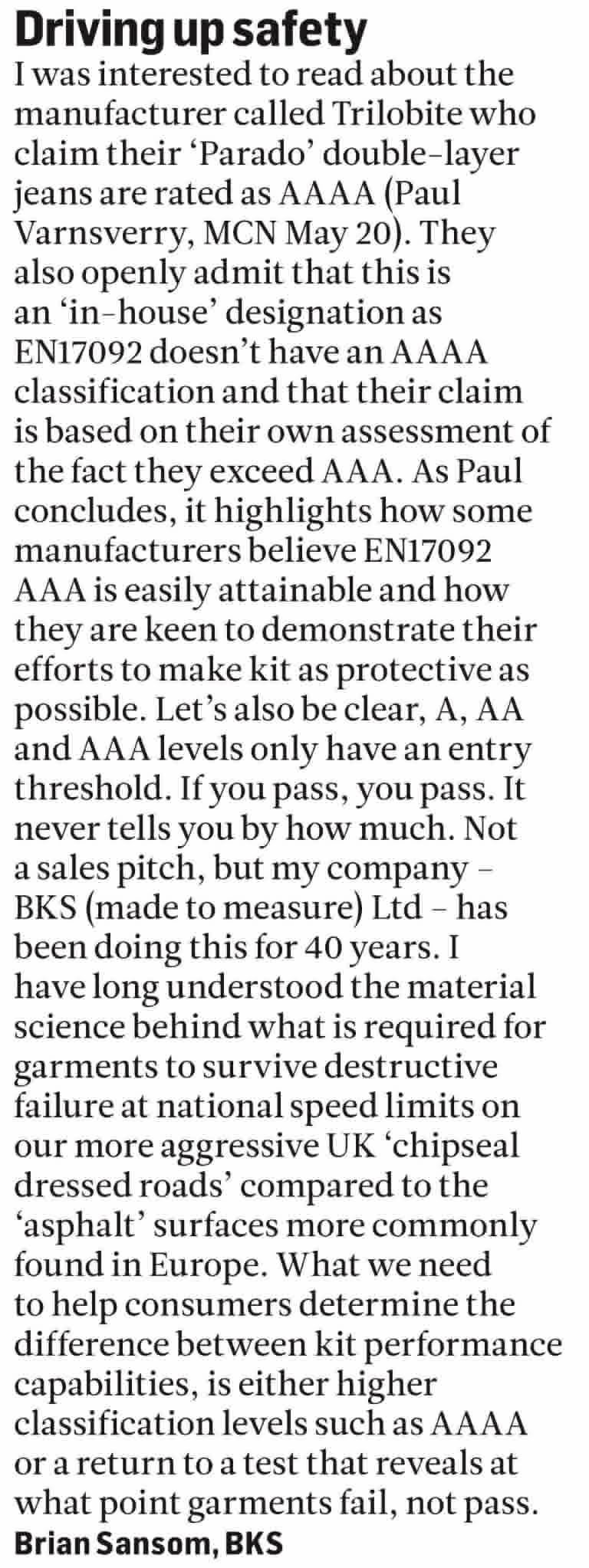


BKS founder Brian Sansom has called for greater transparency in motorcycle clothing safety standards, highlighting the need for riders to understand not just whether a garment passes a test, but how well it performs.
Brian's comments were published in Motorcycle News (MCN), following a discussion around the use of an “AAAA” designation by motorcycle clothing manufacturers. His letter questioned what current certification classifications tell riders about the actual performance of protective clothing.
Under the current EN 17092 standard, AAA is the highest recognised classification. Brian's concern is that the classification system establishes a threshold for each level, but doesn't necessarily tell consumers how far a garment exceeds that threshold.
As Brian explains, “A, AA and AAA levels only have an entry threshold. If you pass, you pass. It never tells you by how much.”
For BKS, this is an important distinction. Protective clothing can meet a particular classification, but that doesn't necessarily mean all garments achieving the same classification offer the same level of performance.
Four decades of understanding protection
Brian's perspective comes from 40 years of developing and manufacturing motorcycle protective clothing.
Since founding BKS in 1986, he has been involved in the development of motorcycle clothing and the testing standards used to assess its protective performance. BKS was among the first manufacturers in Europe to achieve CE approval for motorcycle apparel and has continued to work with demanding protective clothing standards throughout its history.
That experience has given BKS a long-standing understanding of the relationship between materials, garment construction and real-world crash performance.
As Brian points out in his letter, the demands placed on motorcycle clothing can be considerable, particularly on UK roads where coarse chipseal surfaces can create very different abrasion conditions from the smoother asphalt commonly found elsewhere in Europe.
For BKS, meeting a standard is therefore an important starting point, but not the end of the conversation.
Looking beyond the pass mark
Brian believes riders would benefit from greater information about the performance of motorcycle clothing, rather than simply knowing that a garment has achieved a particular classification.
One potential solution would be the introduction of higher classification levels that allow manufacturers to demonstrate performance beyond AAA. Another would be a return to testing that shows when and how a garment fails, rather than simply establishing that it has passed a particular threshold.
This would give riders a clearer understanding of the differences between garments and allow manufacturers who invest in higher levels of protection to demonstrate that performance.
The issue is particularly relevant as motorcycle clothing continues to develop, with manufacturers using increasingly advanced materials, construction techniques and protective technologies.
Protection has always been at the heart of BKS
At BKS, the pursuit of improved protection has been part of the company's philosophy since its foundation.
Today, BKS continues to combine traditional craftsmanship and bespoke tailoring with modern materials, technology and independent certification. Its bespoke motorcycle suits are developed with protection, fit and performance considered together, rather than treating certification as the sole measure of a garment's capability.
Brian's comments in MCN reflect a belief that riders should have the information they need to make informed decisions about their protective clothing — and that the industry should continue looking for ways to demonstrate genuine differences in performance.
Because when it comes to motorcycle protection, passing the test is important. Understanding how well you pass it could be even more important.